
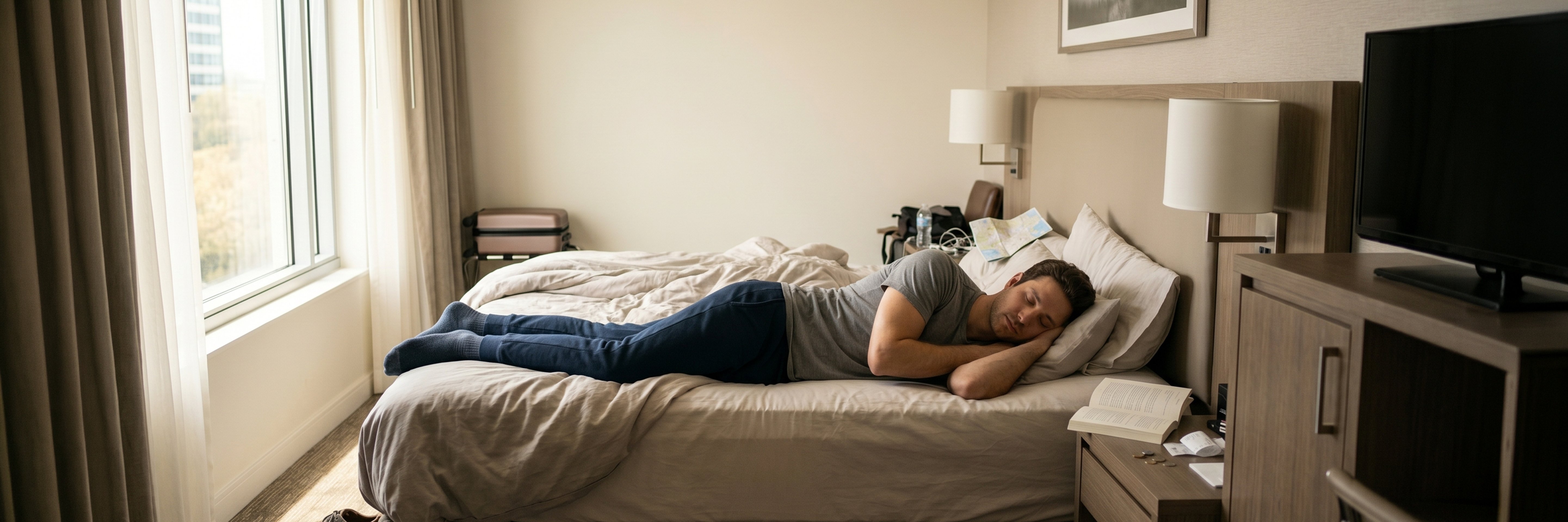
There are times when you’re not looking for “somewhere to go”, but for a way to feel better again. It isn’t always dramatic exhaustion. Sometimes it’s a broken-up day, constant noise, and the feeling of being in between things with nowhere to properly stop. In those hours, rest isn’t a treat; it’s maintenance. That’s where a day use room can be a simple, surprisingly effective solution: a few hours in a space that’s yours, with a door that closes, a bed, a bathroom, and the chance to properly breathe. You don’t need to disappear - you just need a smart pause so you can carry on with steadier energy and a clearer head.
The real problem: tiredness builds up and ordinary breaks don’t help you recover
Most people don’t look for a hotel room during the day because they “want a hotel”. They end up here because the alternatives don’t work: cafés are noisy, a bench isn’t rest, a waiting area is a compromise, and the car is uncomfortable and often leaves you feeling more tense. And tiredness isn’t always just sleepiness. Often it’s overload, mental clutter, and low-level tension that lingers even when you technically have some time free.
The point is that a proper break needs three things: privacy, basic comfort and a minimum amount of protected time. Without those conditions, you can spend hours simply “getting through it” rather than actually recharging. That’s why day use can be the most straightforward choice when you feel you need a quick but complete reset - not an escape, just a temporary base for a few hours that helps you feel like yourself again.
What a day use room should provide when you need rest anywhere
Day use works best when it answers practical needs, even if we don’t always describe them that way. You’re not necessarily looking for anything exceptional. You’re looking for what helps you feel calmer, clearer and more put together before you continue your day.
- Quiet and privacy so you can properly switch off
- Comfort for a short but effective rest
- A private bathroom to freshen up (and shower if needed)
- Clear time slots that make planning simple
- A sense of control: your space, your pace, no improvising
Quiet and privacy matter because your mind recovers when it stops scanning what’s happening around you. Comfort matters because even a short pause can be genuinely useful when there’s a proper bed and a tidy room.
Freshening up isn’t just cosmetic. A shower can create a real before-and-after in the middle of the day. Clear time slots make the decision practical: you know what you’ve got, you fit it in, and you take the break without extra stress. And the sense of control is huge - having a room to yourself for a few hours reduces the mental friction that comes with a packed, broken-up schedule.
How day use works
Day use means booking a hotel room for daytime hours only, without staying overnight. You choose a time slot - morning, afternoon, or a specific block - depending on the property. You arrive, check in, use the room during your reserved window, then check out when it ends.
The key is predictability. This isn’t about hoping you can come and go whenever. It works when the timing is clearly defined and the slot you choose leaves enough room to actually rest, not just pop in briefly. In practice, you’re booking a few hours and expecting a ready room, a private bathroom and a calm environment. It’s simpler than it sounds because it removes the guesswork: you know where you’re going, how long you’ll be there, and you can use that time as real recovery.
Use cases: real situations where day use can change the day
A broken-up day between commitments: “I’ve got three free hours and I don’t want to waste them”
Context: there’s a gap between appointments and you already know that spending those hours “somewhere” will leave you more drained.
Day use solution: a room for a few hours becomes a stable base. You can lie down, close your eyes, breathe, and head back out more centred.
After a demanding morning: “I need a reset, not another coffee”
Context: stress, calls, queues, traffic - by midday your head is full.
Day use solution: a short pause in privacy, at your pace, without needing to buy something just to justify sitting somewhere.
Before an evening plan or event: “I want to arrive well, not running on empty”
Context: you’ve got something later and you’re already tired - and you may need to change and get ready, too.
Day use solution: you check in, rest, shower if needed, and get ready calmly without rushing.
“I can’t properly rest when working from home”: changing environment to recover
Context: home comes with distractions, notifications, noise and unfinished tasks. Even when you stop, you don’t really recharge.
Day use solution: a neutral space helps you properly switch off for a few hours and return with cleaner energy.
Physical recovery after being on your feet: “I’m exhausted - I need to lie down”
Context: lots of walking, a workout, heat, or a long day standing can leave your body feeling heavy.
Day use solution: a bed and a steady environment let you recover properly, even if it’s only for a short time.
An “invisible” break while you’re out in the city: “I’m away from home, but I don’t want to stay in the middle of everything”
Context: you’re in town for work, errands, or meetings and you don’t have a base where you can take a proper break.
Day use solution: the room becomes your temporary base - rest, order, and a calmer restart before you continue.
Frequently asked questions (FAQ)
Can I book a room for just a few hours?
Yes. That’s exactly what day use is designed for. You book a time slot and use the room for a few hours without an overnight stay.
How do check-in and check-out work for day use?
They’re tied to your booked window: check-in at the start of the slot and check-out at the end. Times can vary by property, so it’s worth checking the details.
How much time do I need for it to feel worthwhile?
It depends, but often 2–4 hours is enough to make a real difference, especially with privacy and a proper bed. The main thing is not choosing a slot that’s too tight.
Can I have a shower and then continue my day?
Usually, yes, because the room includes a private bathroom. If it matters to you, check the facilities and booking conditions.
Is it a good option if I can’t rest properly while working from home?
It can be, because changing environment creates a clear break. If home keeps you “switched on”, a neutral space can help you recover better.
Do I need to book far in advance?
If you know your day will be broken up, booking ahead can help you choose the best slot. If your schedule is unpredictable, look for flexible conditions.
Is a morning slot or an afternoon slot better?
It depends on your routine. Morning works if you need recovery after an early start; afternoon is often better for avoiding the mid-day slump or getting ready for something later.
What happens if I arrive late?
That depends on the booking conditions. Choose a slot with some buffer and read the access, change and cancellation rules.